
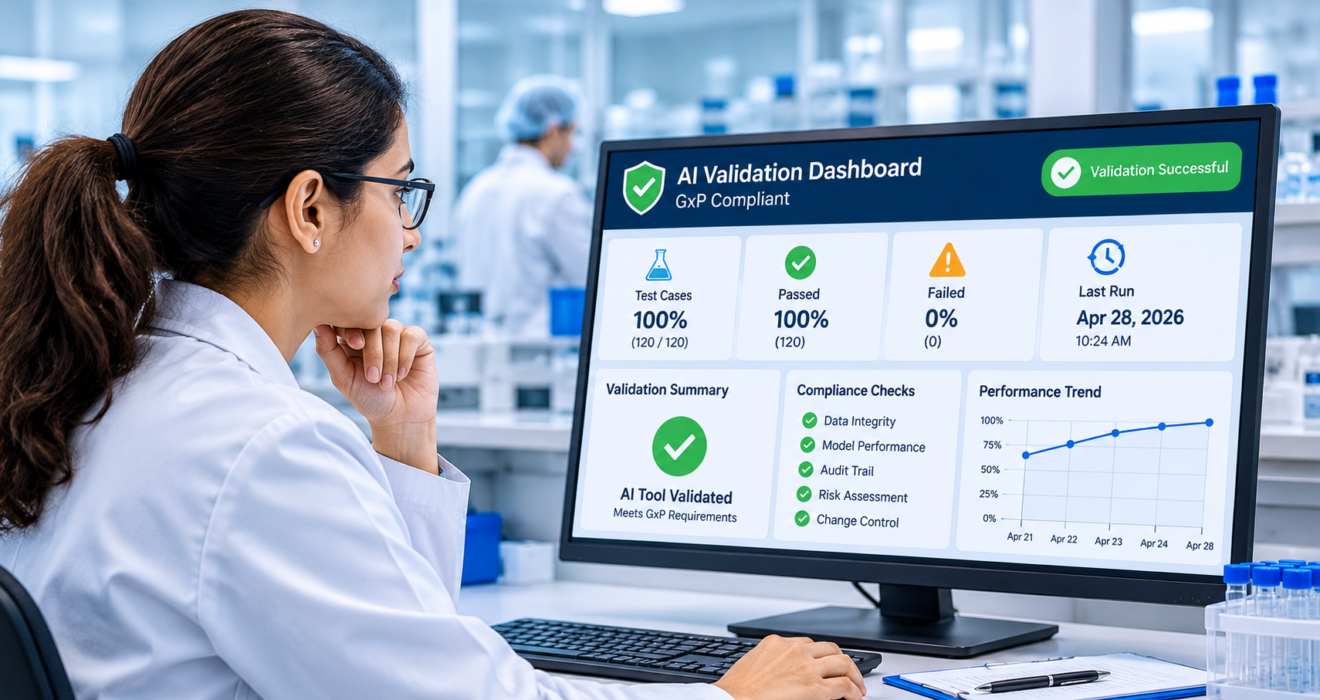
Validating AI Tools in GxP: Where to Start
Bringing artificial intelligence into pharmaceutical operations without compromising compliance
Quick answer: To validate an AI tool in GxP, start with its intended use, not the product. Define exactly what the tool will do, assess its impact on product quality, patient safety and data integrity, then test it on real, messy data against acceptance criteria set in advance. Design human review deliberately and control every model change.
Quick answer: what drives the cost of a CSV project? The cost of a computer system validation project is driven mainly by seven factors: (1) system complexity and intended use, (2) GxP risk and validation scope, (3) required deliverables and approvals, (4) interfaces, integrations and data migration, (5) supplier evidence and cloud/SaaS responsibilities, (6) testing, data integrity and electronic records requirements, and (7) timeline, stakeholder capacity and rework. A reliable CSV budget estimates role-based effort for each work package, adds supplier and tooling costs, and includes a justified contingency rather than a fixed percentage.
Key takeaways:
● Start with the process and intended use, not with the vendor’s demo.
● Validation effort should match risk: drafting help under QA review needs less assurance than a tool that classifies critical deviations.
● Test on realistic, incomplete and difficult records, with acceptance criteria fixed before testing.
● A human review step is necessary but not sufficient. It must be designed, and tested where it is relied on as a control.
● Model updates, prompt changes and new data can all change outputs, so they go through change control.
● As of November 2026, FDA’s AI guidance and EU GMP Annex 22 are both still drafts. Annex 11, 21 CFR Part 11 and ICH Q9(R1) already apply.
Is the Pharmaceutical Industry Ready to Validate AI?
AI is already entering pharmaceutical operations, and most companies are still working out how to validate it. It is finding its way into manufacturing, quality assurance, quality control, regulatory affairs, engineering and supply chain management.
Today, AI tools are being explored for reviewing deviations, preparing investigation summaries, identifying process trends, analyzing laboratory results and supporting documentation. Some applications are straightforward. Others may directly influence decisions that affect product quality.
The benefits are clear. AI can help professionals review large volumes of information, spot patterns that might otherwise be missed, and reduce time spent on repetitive work.
But pharmaceutical manufacturing is not an industry where a technology can be adopted simply because it is faster. A tool that performs well in a demonstration may not perform reliably on real manufacturing data, incomplete records, unusual process conditions or complex investigations.
That raises the central question:
If we introduce AI into a GxP-regulated activity, how do we show that its output is reliable, its risks are controlled, and it remains suitable for its intended use?
This is where AI validation becomes essential.
Why Isn’t Traditional Computerized System Validation Enough for AI?
Traditional computerized system validation still applies to AI, but it does not cover how some AI systems produce their outputs.
Pharmaceutical companies have validated ERP, LIMS, MES, electronic batch records and eQMS for years through documented requirements, risk assessments, testing, change control and periodic review. Those principles remain relevant.
The difference is in how the output is generated. In a conventional rule-based system, predefined logic determines the result: if a condition is met, the system follows a set rule. Machine learning models and large language models (LLMs) behave differently. Their results depend on training data, model configuration, context and the information supplied at the time of use.
Consider an AI tool that assists with deviation investigations. It reviews a deviation description and recommends a possible root cause. Often the recommendation is useful. But when a similar deviation occurs under slightly different conditions, the tool may miss a critical detail and suggest the wrong conclusion.
The concern is not that AI can make mistakes. People and conventional systems make mistakes too. The concern is whether the organization understands when the AI may fail, has controls in place, and can show those controls work.
In a GMP environment, a convincing answer is not necessarily a correct answer. That matters most when AI output supports quality decisions.
What Do Regulators Expect From AI in GxP?
Regulators expect the same things they always have: understand the system, assess the risk of its intended use, control it, and keep evidence that it performs as required. Here is where the main documents stand as of November 2026.
Two points matter for anyone planning an AI project.
First, the proposed Annex 22 is still a draft and should not be presented as a finalized, enforceable requirement. Second, the current draft states that it does not apply to generative AI and LLMs, or to dynamic and probabilistic models, and that such models should not be used in critical GMP applications. The EMA’s 2026 workshop discussed widening that scope, but the published draft has not changed.
Meanwhile, the existing foundations still apply: EU GMP Annex 11, 21 CFR Part 11 for electronic records and signatures, ICH Q9(R1) for quality risk management, and FDA’s risk-based thinking in its Computer Software Assurance guidance.
AI does not remove these responsibilities. It adds considerations that need to be built into an established pharmaceutical quality system.
Where Should a Pharmaceutical Company Start With AI Validation?
Start with the process the AI is meant to improve, not with the AI product. A supplier may show an impressive tool that drafts deviation reports, writes SOPs or analyses manufacturing data. Before going further, the company must understand exactly how that tool will be used in its own operations.
Take an AI application proposed for deviation management. Will it only suggest categories? Recommend root causes? Draft investigation reports? Or influence whether a deviation is closed? These are very different applications from a GMP risk perspective, even when the technology is the same.
A tool that helps draft text under effective QA review needs a different level of assurance from one that automatically classifies critical deviations and influences batch decisions.
A practical 6-step starting framework
1. Define the intended use: What the tool does, for whom, on which data, and where it must not be used.
2.Assess GxP impact: Its potential effect on product quality, patient safety and data integrity.
3.Classify the risk: Probability of a wrong output, its consequence, how easily it would be detected, and existing controls.
4. Set requirements and acceptance criteria Before any testing starts.
5.Test under real conditions: Routine, incomplete and challenging cases, with human review in the loop where it is a control.
6. Plan lifecycle control: Change control for models, prompts and data, plus monitoring and periodic review.
How Do You Run a GxP Risk Assessment for an AI Tool?
Assess the probability of an incorrect output, the consequence of that error, the ability to detect it, and how well existing controls work. Not every AI application carries the same risk.
This table is illustrative. Each company’s own risk assessment decides the level.
In a typical facility, production may want AI to spot unusual process trends, QA may want to review recurring deviations, and engineering may want predictive maintenance for critical equipment. All three use AI, but the consequences of a wrong output differ. A false trend may lead to an unnecessary investigation. Missing an emerging critical process issue is far more serious.
This is where manufacturing, QA, QC, engineering and validation experience matters. A risk assessment prepared only from an IT perspective can miss important process failure scenarios.
Example: Validating AI for Deviation Investigations
Deviation management is one of the most promising areas for AI, and a good test of what validation must cover.
QA teams spend a lot of time reviewing historical deviations, finding similar incidents, examining trends and evaluating recurring problems. An AI application could help by finding related deviations, retrieving records and suggesting investigation pathways.
Now imagine a recurring equipment deviation linked to an unexpected temperature fluctuation. The AI finds earlier deviations involving temperature variation and recommends equipment calibration as a possible root cause.
The recommendation looks reasonable. But what if the real cause is a process control sequence, an intermittent sensor failure or an incorrect operating practice? If the team accepts the AI suggestion without proper technical assessment, the deviation may be closed with the wrong root cause. The CAPA then addresses the wrong problem, and the deviation recurs.
So validation must go beyond whether the tool produces relevant-looking answers. It should check that the system:
• retrieves the right information,
• represents source records accurately,
• recognizes uncertainty, and
• avoids unsupported conclusions.
It should also define how QA reviews and approves AI output before it is used in a formal investigation. Note that if the tool is built on a generative AI model or LLM, the current Annex 22 draft says it should not be used in critical GMP applications, so its role should stay supportive and clearly reviewed until the final text says otherwise.
The aim is not to stop AI. It is to make sure AI supports investigations without weakening scientific judgment or quality responsibilities.
What Should an AI Validation Approach Include?
Once intended use and risk are set, an AI validation strategy for a GxP process should cover five areas.
1. Clear user requirements. “The tool should analyse deviations accurately” is not a requirement. Describe expected functions, data sources, users, limitations, the review process, and the situations where the system must not be used.
2. Data quality. AI performance depends heavily on its data. Historical deviation records may contain inconsistent classifications, incomplete investigations, outdated terms or conclusions later revised. If those records are used to build or evaluate the AI, assess their quality and suitability, using the same ALCOA+ data integrity controls you apply elsewhere. Keep test data independent of training data.
3. Testing under real operating conditions. Tests built only on well-written, simple examples give a false picture. Real deviation reports contain missing information, inconsistent terms, multiple contributing factors and complex observations. Include routine cases and difficult cases where a wrong recommendation would create real quality risk.
4. Acceptance criteria set before testing. Depending on the application, these may include classification performance, critical error rates, source accuracy, consistency, uncertainty handling and the effectiveness of human review.
5. Control after go-live. A tool that passes initial validation may behave differently after a model update, a database change or a configuration change. These changes need a lifecycle management process.
Is Human Review Enough to Make AI Compliant?
No. Human review is necessary but not sufficient. Adding a review step does not by itself make an AI application compliant or controlled.
The reviewer must understand the tool’s purpose and limits and have enough source information to verify its output. If a reviewer receives only an AI-generated investigation summary, with no way to trace the supporting records, meaningful verification is difficult.
There is also automation bias. When a tool keeps giving useful answers, users can come to over-trust it, and review slowly turns into routine approval instead of an independent technical check.
So human oversight must be designed into the workflow and, where it is relied on as a risk control, tested for effectiveness. The reviewer must keep the authority, technical understanding and responsibility for the final decision, supported by proper training such as CSV training. AI can help pharmaceutical professionals make decisions, but accountability for regulated quality decisions stays with people.
What Happens When the AI Model Changes?
Any change that could alter the AI’s output needs assessment under change control, and the AI must not change its approved behavior without authorization. Keeping the validated state over time is one of the hardest parts of AI validation.
Conventional software changes go through documented change control and testing. AI adds more variables:
•the supplier releases a new model version,
• a knowledge database is updated,
• the prompts used to get responses are revised, or
• the model is retrained on additional production data.
Each of these can change the output. A tool validated for deviation categorization on one model version may not give identical results after a supplier upgrade.
The company needs a clear process to decide which changes need assessment, extra testing, approval or revalidation, supported by records and audit trails that show what changed and when. Supplier agreements should cover update notification, version control, availability, data protection and technical support.
How Do You Build a Sustainable AI Validation Program?
Build one AI governance framework inside your existing quality management system rather than validating each tool from scratch. Validating tools one by one leads to inconsistent practice and wasted effort.
The framework should define how AI applications are assessed before purchase, how intended use is approved, how GxP risk is classified, how suppliers are evaluated, and who owns validation. It should also set requirements for training, access control, monitoring, incident management, periodic review and change control. QA, IT, validation, manufacturing and other departments should take part according to the application. (See QCLYNX quality management solutions.)Keep it practical. A low-risk administrative AI tool should not get the same validation as a tool that influences critical manufacturing or quality decisions. The documented assurance should match the potential impact.
A Sensible Way Forward: Start With One Pilot
For companies starting out, pick one clearly defined use case instead of rolling AI out across several departments at once. A controlled pilot helps the organization understand technical limits, measure real benefits, develop validation procedures and find gaps in existing quality systems. What is learned then supports a wider AI strategy. A pilot also brings QA and validation teams in early, rather than only when the software is ready to deploy. In regulated pharmaceutical operations, compliance works best when it is part of system selection and design, not added at the end.
Frequently Asked Questions (FAQ)
Conclusion: AI Adoption Must Be Backed by Quality Assurance
AI will keep changing how pharmaceutical companies manage information, monitor processes, investigate deviations and support quality decisions. Its potential to improve efficiency is significant. The real value depends on introducing it without weakening the controls that underpin GMP compliance.AI validation should start with a clear understanding of the intended application, its GxP impact, the reliability of its data and outputs, and the responsibilities of the people using it. A well-designed strategy does not need to make AI complicated. It should give the level of assurance the risk justifies and keep controls in place across the system lifecycle.
For pharmaceutical manufacturers, the challenge is not to adopt AI faster. It is to adopt AI in a way that is scientifically justified, operationally practical and defensible during regulatory inspection. That is where a well-structured, risk-based validation approach makes the difference.
Planning an AI pilot in a GxP process? QCLYNX helps pharmaceutical teams define intended use, assess GxP risk and build proportionate validation. Explore our AI/ML validation services for GxP or contact our team.
References:
1. US FDA. Considerations for the Use of Artificial Intelligence to Support Regulatory Decision-Making for Drug and Biological Products. Draft guidance, January 2025.
2. FDA and EMA. Guiding Principles of Good AI Practice in Drug Development. January 2026.
3. European Commission. EudraLex Volume 4, Proposed Annex 22: Artificial Intelligence. Public consultation, July 2025.
4.EMA. Good Manufacturing Practice Multistakeholder Workshop on Expert Contributions to Artificial Intelligence Guidance Development (Annex 22). Report EMA/156789/2026, workshop 30 June 2026.
5. European Commission. EudraLex Volume 4, Annex 11: Computerized Systems.
6.ICH. Q9(R1): Quality Risk Management.
7.US FDA. 21 CFR Part 11: Electronic Records; Electronic Signatures.
