
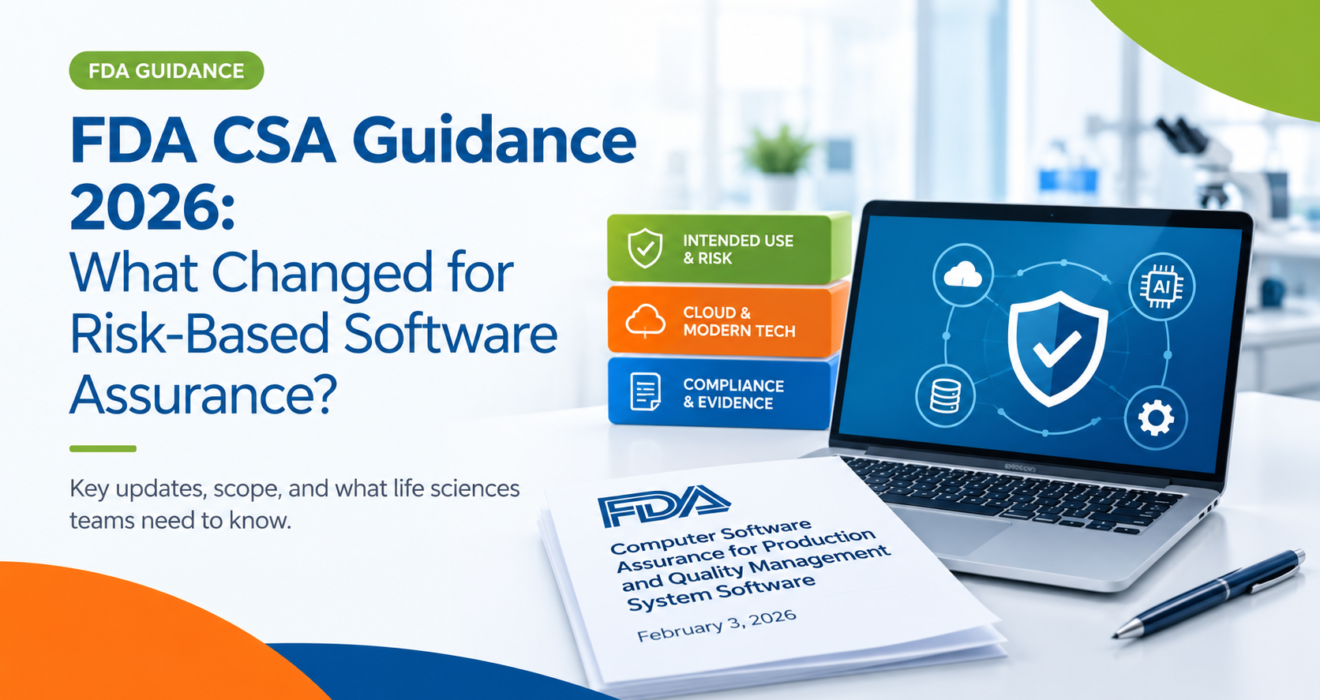
FDA CSA Guidance 2026: What Changed for Risk-Based Software Assurance?
The U.S. Food and Drug Administration (FDA) updated its Computer Software Assurance (CSA) guidance on February 3, 2026, to align with the Quality Management System Regulation (QMSR), which took effect the previous day. The revised guidance, Computer Software Assurance for Production and Quality Management System Software, replaces guidance issued in September 2025 and describes how manufacturers can apply risk-based assurance to software used in medical device production and quality management systems.
The update emphasizes the importance of intended use, risk proportionate assurance activities and appropriate evidence. It also covers cloud computing and other contemporary software technologies. Applicability is the key consideration for pharmaceutical, biotechnology, contract research organization (CRO) and contract development and manufacturing organization (CDMO) teams. The guidance has a defined medical device scope and should not be automatically considered a universal pharmaceutical validation requirement
What Is the FDA Computer Software Assurance Guidance?
Computer Software Assurance is a risk based approach to establishing confidence that software is fit for its intended use. It focuses assurance activities on the software functions and processes where failure could have meaningful consequences for product quality or safety.The FDA's February 2026 guidance addresses computers and automated data-processing systems used as part of medical device production or the quality management system. Its purpose is to help manufacturers select appropriate testing and assurance activities while meeting applicable quality system obligations. The official guidance is available from the FDA's Computer Software Assurance guidance page.
How Does CSA Relate to Computerized System Validation?
Computerized System Validation (CSV) is the broader practice of establishing and documenting that computerized systems are suitable for their intended use in a regulated environment.
CSA provides a risk based approach to software assurance within its stated scope. It does not mean that organizations should abandon validation, remove necessary controls, or stop maintaining evidence.
A sound assurance strategy considers intended use, system functionality, risk, supplier capabilities, testing, documentation, and lifecycle changes. Pharmaceutical organizations must also evaluate their applicable good manufacturing practice (GMP), electronic record, and other regulatory requirements independently.
What Changed in the FDA's 2026 CSA Guidance?
The February 2026 revision aligns the guidance with the QMSR and provides additional clarification for applying CSA to contemporary software environments. The principal changes and clarifications include:
Updated regulatory references: The guidance aligns with the QMSR framework and ISO 13485:2016 rather than relying on the previous 21 CFR 820.70(i) reference.·
Cloud terminology: The updated guidance defines cloud related service models, including infrastructure as a service (IaaS), platform as a service (PaaS), and software as a service (SaaS).
Modern software technologies: It discusses applying risk-based assurance principles to automation, data analytics, artificial intelligence, and machine learning when used within the guidance's scope.
An additional SaaS example: The guidance includes an example involving a SaaS product lifecycle management system.
Software changes: It provides additional discussion of changes to production or quality management system software.
Assurance records: It gives clearer recommendations for the information an appropriate assurance record should contain.
Electronic records: It includes a dedicated discussion of considerations related to 21 CFR Part 11.
These changes should be interpreted in context. Risk based assurance was not invented in February 2026, and the revised guidance does not eliminate applicable software validation obligations. The FDA's official guidance document should be used as the definitive reference for interpreting its recommendations.
What Does Risk-Based Computer Software Assurance Mean?
Risk-based CSA means selecting assurance activities according to the software's intended use and the consequences of its failure.
The assessment should consider the function being evaluated, how that function affects the regulated process, whether a failure could affect product quality or safety, and what evidence is needed to establish confidence in the result.
A useful assessment considers:
●Intended use and critical functions.
●Potential consequences of incorrect processing or output.
●Product quality and safety implications.
●Data integrity and record reliability.
●Existing technical and procedural controls.
●Supplier documentation and testing evidence.
●The extent of testing and documentation needed to demonstrate suitability.
The appropriate level of assurance should be supported by a clear rationale rather than by an arbitrary risk label.
Illustrative Risk Examples
Note: The final decision depends on the actual intended use, applicable regulatory requirements, and a documented risk assessment.
CSA vs. Traditional CSV: What Is the Difference?
CSA and CSV are not mutually exclusive. CSV describes the broader validation discipline, while CSA emphasizes a risk-based approach to software assurance within the FDA guidance's scope. Consideration Conventional CSV implementation Risk-based CSA approach
1. Starting point Often organized around system requirements and validation deliverables. Starts with intended use and relevant software functions.
2. Risk assessment May be documented separately from testing decisions Directly informs the assurance approach.
3. Testing May rely heavily on predefined scripted tests Can use scripted, unscripted, or combined methods as appropriate.
4. Documentation Can produce extensive documents and screenshots Focuses on sufficient, useful and reviewable evidence
5. Supplier evidence May repeat testing without assessing existing evidence Evaluates suitable supplier evidence alongside the organization's own responsibilities
6. Life cycle management Depends on established change-control procedures Continues to apply risk-based assessment to relevant changes
7. Objective Demonstrate suitability and compliance Demonstrate suitability and compliance with proportionate assurance activities
The distinction is not that traditional CSV is automatically noncompliant or that CSA always requires less testing. Both approaches must provide sufficient confidence and meet the requirements that apply to the organization and system.
What Testing Methods Can Organizations Use?
The FDA guidance discusses different testing activities and the importance of selecting methods appropriate to the intended use and risk. Depending on the function and risk, an organization may consider:
‣Scripted testing: Predetermined steps and expected results, useful where repeatability and explicit verification are important.
‣Unscripted testing: Testing guided by objectives and tester judgment, including exploratory testing and error-guessing techniques where appropriate.
‣Combined testing: A planned combination of scripted and unscripted activities to address different risks within a function.
Testing should have clear objectives and produce evidence that supports the assurance conclusion. Unscripted testing is not an excuse for undocumented testing, and scripted testing is not automatically sufficient simply because every step was executed. Organizations should document the rationale for their chosen method, investigate significant issues, and establish that unresolved problems do not undermine the intended use.
What Documentation and Evidence Should an Assurance Record Include?
Risk-based assurance does not mean eliminating documentation. It means retaining appropriate evidence to explain the assurance decision and demonstrate that the software is suitable for its intended use. The February 2026 guidance provides recommendations for appropriate records, including information about:
1. The intended use of the software feature, function, or operation.
2. The results of the risk-based analysis.
3. The testing performed.
4. Issues identified during testing, such as failures, defects, or deviations.
5. The conclusion regarding acceptability for the intended use and the resolution of relevant issues.
6. Who performed the testing and when, with review or approval where appropriate.
Organizations should align their records with the applicable guidance and their quality procedures. System-generated logs, test results, audit trails, and other electronic evidence may be useful when their reliability and relevance are established.The aim is to make the evidence clear, traceable, reviewable, and proportionate to risk—not simply to maximize the volume of paperwork.
What Does the 2026 Guidance Mean for Pharmaceutical and Life Sciences Companies?
The FDA's CSA guidance specifically addresses software used in medical-device production and quality management systems. Pharmaceutical manufacturers should not assume that the document independently establishes a new, universal validation framework for every GxP computerized system.
Pharmaceutical and biotechnology organizations should determine which regulations and guidance documents apply to each system and intended use. Depending on the system, relevant considerations may include applicable drug GMP requirements, electronic records and signatures, data integrity, supplier oversight, and established computerized system lifecycle practices. The guidance's risk-based concepts may be useful when reviewing assurance strategies, but any application beyond its defined scope should be justified against the requirements that actually govern the system.
For example, a pharmaceutical company evaluating a quality management platform should establish its intended use, determine the applicable regulatory requirements, assess electronic-record implications, evaluate supplier evidence, and define testing and lifecycle controls. It should not rely on the device-focused CSA guidance as a substitute for that regulatory assessment.
How to Assess Your Existing CSV/CSA Program
A structured assessment can help organizations identify gaps in risk decisions, testing, evidence, supplier oversight, and lifecycle controls.
Step 1: Confirm regulatory applicability
Identify the system's intended use, business process, regulated activities, and applicable regulations or guidance. Distinguish medical-device QMS software from pharmaceutical GxP systems and other enterprise applications.
Step 2: Review your software inventory
Document the systems and relevant functions supporting regulated processes. Include deployment model, business owner, supplier, interfaces, data handled, and applicable quality responsibilities.
Step 3: Reassess risk and criticality
Review existing risk assessments and confirm that testing decisions are supported by documented reasoning. Consider data integrity, product quality, safety, and the consequences of failure.
Step 4: Evaluate testing and objective evidence
Determine whether testing adequately addresses intended use, critical functions, error handling, permissions, calculations, interfaces, and other relevant risks. Identify redundant activities as well as insufficient testing.
Step 5: Assess suppliers and cloud services
Review supplier capabilities, relevant testing documentation, security and data integrity controls, service agreements, backup and recovery arrangements, and change-notification practices. Decide which supplier evidence is suitable and what additional verification is needed.
Step 6: Review electronic records and signatures
Determine whether 21 CFR Part 11, predicate rules, or other electronic-record requirements apply. Document the rationale and verify the controls relevant to the records and processes in scope.
Step 7: Strengthen change control
Assess software updates, configuration changes, integrations, migrations, and other changes according to their potential impact. Define appropriate regression testing, approvals, documentation, and ongoing monitoring.
Step 8: Update procedures and train stakeholders
Where necessary, revise procedures, templates, risk-assessment methods, and training materials. Ensure that quality assurance, IT, system owners, validation specialists, and suppliers understand their responsibilities.
Common CSA Implementation Mistakes to Avoid
Organizations should avoid these common problems when implementing a risk-based assurance strategy:
1. Treating CSA as a way to eliminate validation.
2. Assuming that all software functions have the same risk.
3. Assigning risk classifications without documented justification.
4. Accepting supplier evidence without evaluating its relevance and reliability.
5. Overlooking data integrity, electronic records, or access controls.
6. Using unscripted testing without defined objectives and suitable evidence.
7. Treating a medical-device guidance document as a universal pharmaceutical requirement.
8. Failing to reassess assurance needs after significant software or process changes.
9. Updating terminology in procedures without changing the underlying risk-assessment and testing practices.
How QCLYNX Can Support Risk-Based CSV and CSA
QCLYNX can present its compliance consulting services as a structured way to evaluate existing validation practices and identify opportunities to strengthen assurance. Relevant services to feature, subject to confirmation of the actual service offerings and destination URLs, include:
Risk-Based CSV Assessment: Review risk classification, testing strategies, and the rationale supporting validation activities.·
CSV/CSA Gap Assessment: Compare current practices with applicable regulatory expectations and identify improvement priorities.·
GAMP 5-Based Validation Strategy: Develop a lifecycle-based approach that considers intended use, risk, supplier involvement, and system complexity.·
Computerized System Validation: Establish and maintain documented evidence of suitability for intended use.·
Risk and Criticality Assessment: Evaluate functions and failure scenarios to inform appropriate assurance activities.
21 CFR Part 11 Assessment: Review the applicability of electronic-record and electronic-signature requirements and relevant controls.·
EU Annex 11 Gap Assessment: Evaluate computerized systems against applicable European GMP expectations.
Data Integrity Assessment: Review controls supporting record completeness, accuracy, reliability, and traceability.
Cloud and SaaS Validation: Assess supplier evidence, configurations, interfaces, changes, and responsibilities.
Data Migration Validation: Evaluate the completeness, accuracy, and integrity of migrated data
Legacy System Assessment: Review existing evidence, system risks, and continuing suitability
Supplier and Vendor Assessment: Evaluate relevant supplier controls, documentation, and oversight arrangements
Audit and Inspection Readiness: Organize evidence and identify gaps that require remediation.
A structured assessment can help organizations identify inconsistent risk decisions, unnecessary duplication, inadequate testing, documentation weaknesses, and potential data integrity risks. Any efficiency improvements should be achieved without compromising applicable requirements or essential controls.
Explore risk-based CSV and CSA services. Contact QCLYNX to discuss your current assurance framework, applicable regulatory requirements, and opportunities for a more consistent, risk-informed approach.
Conclusion
The updated Computer Software Assurance (CSA) guidance issued in February 2026 continues from previous versions, aligning validation expectations with the FDA’s modern Quality Management System Regulation (QMSR) and ISO 13485 standards.
The central principle remains that assurance should be appropriate to intended use and risk, supported by relevant testing and sufficient objective evidence. Organizations should distinguish the guidance's specific scope from other computerized system requirements and assess each system against the regulations that actually apply.
For life sciences companies that want to assess or enhance their current validation strategy, a comprehensive CSV/CSA assessment provides a roadmap for the way forward. It brings together regulatory applicability, risk-based decision making, testing methods, documentation practices, supplier management, and ongoing lifecycle controls into one.
