
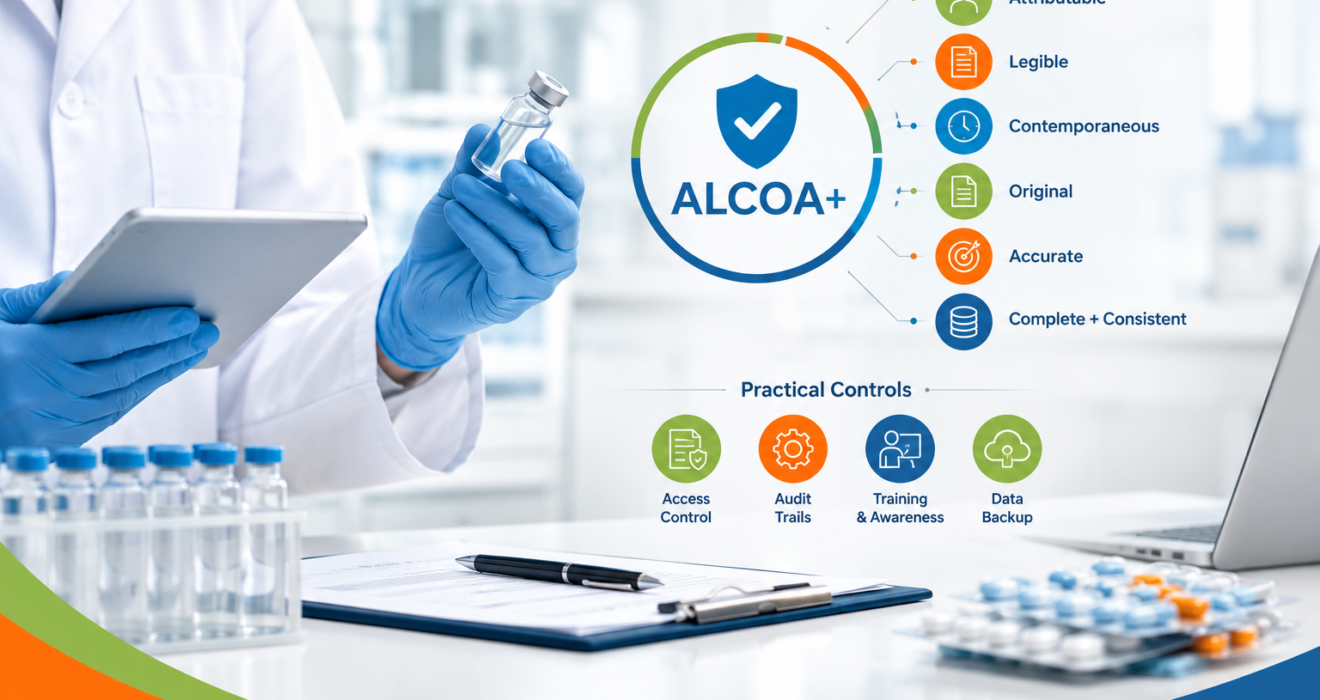
Data Integrity in Pharma: From ALCOA+ to Practical Controls
Data integrity remains at the forefront of global regulatory inspections. Health authorities—including the US FDA, EMA, Health Canada, and PMDA—continue to issue warning letters and non-compliance notices for data management failures in pharmaceutical operations. Achieving sustainable compliance requires moving beyond memorizing the ALCOA+ framework to embedding practical, automated controls within daily GxP operational workflows.
Quick Summary: What is Data Integrity in Pharma?
Pharma data integrity refers to the completeness, consistency, accuracy, and trustworthiness of data throughout its entire lifecycle. Regulators evaluate data integrity through the ALCOA+ framework (Attributable, Legible, Contemporaneous, Original, Accurate + Complete, Consistent, Enduring, Available) enforced by frameworks such as FDA 21 CFR Part 11 and EU GMP Annex 11.
What Challenges Do Pharma Companies Face in Data Governance?
Modern biopharmaceutical manufacturing and quality control laboratories generate massive volumes of electronic records across disparate systems (such as LIMS, CDS, MES, eQMS, and ERP). Managing data integrity across these interconnected, multi-vendor environments presents three major operational hurdles:
Inconsistent ALCOA+ Application: Quality teams often understand ALCOA+ theoretically but struggle to translate these nine principles into actionable, system-level Technical SOPs.
Manual Data Bottlenecks: Heavy reliance on manual transcriptions, standalone spreadsheets, and legacy hybrid systems increases human error and creates data vulnerability points.
Overwhelming Audit Logs: Reviewing thousands of lines of raw system audit trails prior to batch disposition drains Quality Assurance (QA) resources, often leading to superficial check-box reviews rather than risk-based oversight.
Why Pharma Data Integrity Matters
Data integrity failures directly jeopardize patient safety, product quality, and commercial continuity across three primary impact areas:
What Global Regulations Say About Data Integrity
Global regulatory frameworks enforce strict data lifecycle management and data governance requirements:
FDA 21 CFR Part 11 & Part 211: Mandates that electronic records are authentic, secure, attributable, and preserved alongside full audit trails and metadata.
EU GMP Annex 11 (and Annex 11 Revision Guidance): Requires formal risk management to ensure electronic data controls maintain the same level of safety and quality as paper records.
WHO, PIC/S (PI 041-1), & MHRA Guidance: Emphasizes establishing a robust Data Governance Culture spanning senior management oversight, IT infrastructure controls, and continuous risk assessments across the entire data lifecycle (creation, processing, review, reporting, and archiving).
Practical Controls: Mapping ALCOA+ to GxP Workflows
To transition from theoretical ALCOA+ principles to robust operational compliance, life sciences organizations must implement technical and procedural controls structured around core governance dimensions:
1. Attributable & Contemporaneous Controls
Eliminate Shared Credentials: Enforce unique, role-based user logins integrated with Single Sign-On (SSO) and Multi-Factor Authentication (MFA).
Automated Time-Stamping: Sync all network-connected lab equipment, manufacturing systems, and database servers to a secure, centralized Network Time Protocol (NTP) master clock to prevent manual clock tampering.
2. Original, Complete, & Legible Controls
Retain Full Metadata: Ensure that "original records" include full metadata (e.g., system parameters, integration algorithms, run logs, and user IDs), not just flattened PDF summaries or paper printouts.
Standardize Long-Term Formats: Store archived electronic records in open-source, non-proprietary formats (such as XML or searchable PDF/A) to guarantee legibility throughout mandatory retention periods.
3. Accurate & Enduring Controls
Risk-Based Audit Trail Review: Shift from full, manual audit trail scans to automated, risk-targeted exception logs that highlight critical events (e.g., record deletions, parameter changes, failed login attempts, re-runs).
Automate Data Pipelines: Integrate instrument interfaces directly with core databases (e.g., connecting CDS directly to LIMS) to eliminate manual transcription steps and validation hazards.
The QCLYNX Perspective: Moving to Automated Compliance
Data integrity is not merely an IT or Quality Assurance checklist; it is an active operational discipline. At QCLYNX, we advocate for a risk-based approach that aligns technical infrastructure with regulatory expectations without slowing down drug development or manufacturing throughput.
By deploying modern Computer Software Assurance (CSA) methodologies, conducting targeted data integrity gap assessments, and engineering automated data controls, life sciences organizations can build resilient operations that remain continuously inspection-ready.
Frequently Asked Questions (FAQ)
Strengthen Your Data Governance Framework
Is your organization prepared for an upcoming FDA or EMA data integrity audit?
Schedule a Consultation with QCLYNX Experts to conduct a targeted Data Integrity Gap Assessment, establish risk-based audit trail review workflows, or optimize your automated GxP systems.
